Anesthesia codes for covered general, regional, or monitored anesthesia are global codes that include all of the following services:
- Pre-anesthesia evaluation
- Anesthetic or analgesic administration
- Intraoperative administration of medications, IV fluids, blood, etc.
- All necessary monitoring of vital signs including blood oxygenation, adequacy of ventilation, circulation and temperature
- Services administered in recovery
- Postoperative visits
These services should not be billed separately.
Coding References
Claims for anesthesia services rendered to HMSA members should be billed using anesthesia codes 00100 through 01999 from the current edition of CPT. Diagnosis codes should be drawn from the current edition of ICD-9-CM/ICD-10-CM. Modifier codes should be selected from the current edition of the CPT or HCPCS coding manual.
Anesthesia Modifiers
Anesthesia modifiers are required to ensure correct reimbursement of anesthesia services. The physician and/or the CRNA shall append the appropriate anesthesia modifier to describe who rendered the service and if it was personally performed, medically directed or medically supervised.
| Modifiers | Description |
|---|---|
| AA | Anesthesia services performed personally by anesthesiologist |
| AD | Medical supervision by a physician: more than four concurrent anesthesia |
| QK | Medical direction of two, three, or four concurrent anesthesia procedures |
| QX | Certified registered nurse anesthesiologist: with medical direction by a physician |
| QY | Anesthesiologist medically directs one CRNA |
| QZ | CRNA service without medical direction by a physician |
Note: An anesthesia modifier is not required for CPT 01996.
Unit Values
HMSA recognizes, with a few exceptions, the 2009 ASA Relative Value Guide as the standard for determining the basic unit value of a procedure.
HMSA recognizes an additional unit for the following physical status modifiers:
- P2 A patient with mild systemic disease
- P3 A patient with severe systemic disease
- P4 A patient with severe systemic disease that is a constant threat to life
- P5 A moribund patient who is not expected to survive without the operation
Note: If multiple anesthesia risk modifiers are billed (Physical Status Modifiers and Anesthesia Risk – Qualifying Circumstances Modifiers ) payment will be made up to the modifier with the highest unit value. No payment will be allowed to the Qualifying Circumstances Modifier when billed in combination with a Physical Status Modifier (P2-P5) that is of equal unit value.
Anesthesia Time Units
Note: This instruction on billing for anesthesia time units apply to HMSA’s private business plans. For Medicare Advantage anesthesia billing instructions refer to the Noridian JE Part B website.
Anesthesia time units should be billed using the total number of minutes. Thus, anesthesia services for 4 hours and 15 minutes would be represented in the “Days or Units” column (24G) as 255.
Anesthesia time begins when the anesthesiologist begins to prepare the patient for the induction of anesthesia in the operating room (or in an equivalent area) and ends when the anesthesiologist is no longer in personal attendance, that is, when the patient may be placed safely under postoperative supervision.
Anesthesia Eligible Charge Formula
[(Base Units x 15) + Minutes + (Physical Status Modifier Unit Value x 15)] x (Conversion Factor Rate ÷ 15) = Eligible Charge
Note: Rounding may affect the Eligible amount.
Post-Payment Review
Claims for anesthesia services are subject to post-payment review. If HMSA’s review of the surgery claim indicates the services did not meet HMSA benefit criteria, the provider will be asked to refund any payment made for anesthesia done in association with the surgery.
Coding Examples
Example 1 (Single modifier)
Anesthesia is provided for lumbar spinal surgery on a patient who has degenerative disc disease and spondylosis. The patient also has mild, controlled hypertension. The surgeon performed a diskectomy, laminectomy, arthrodesis and attached non-segmental spinal instrumentation. The anesthesiologist was in attendance for 4 hours and 15 minutes (255 minutes). The CMS 1500 claim form would be completed as shown in this example of a single modifier.
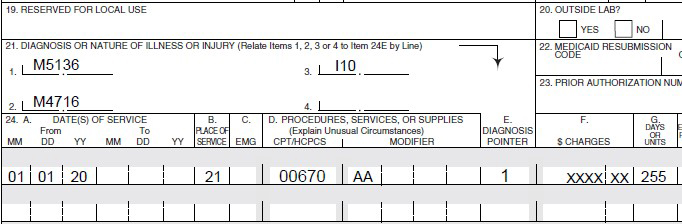
The only modifier needed in this example is:
| Code | Description |
|---|---|
| AA | Indicating the anesthesia was personally performed by the anesthesiologist |
Example 2 (Multiple modifiers)
The patient is having surgery on the popliteal vein due to phlebitis. The anesthesia is being administered by a CRNA under the medical direction of an anesthesiologist and is complicated by the patient’s prone position. The CRNA was in attendance for 1 hour (60 minutes). The claim would be coded as shown in this example using multiple modifiers.
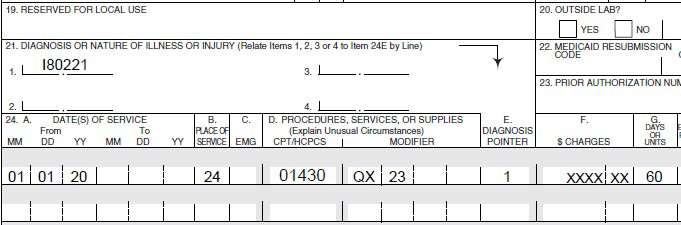
The modifiers used are as follows:
| Code | Description |
|---|---|
| QX | Indicating the anesthesia was administered by a CRNA under the medical direction of an anesthesiologist |
| 23 | Indicating anesthesia services complicated by other than supine position |
Note: Anesthesia risk modifiers should only be billed by the practitioner actually administering the anesthesia. When anesthesia is administered by a CRNA under the medical direction of an anesthesiologist, the CRNA may use the anesthesia risk modifier on his or her claim, but the anesthesiologist may not.
Revision History
| Date | Nature of Revision |
|---|---|
| 08/03/2026 | Migrated to new platform.
|