Modifier codes sometimes are used to indicate unusual circumstances related to anesthesia services. HMSA recognizes the five-digit qualifying circumstances codes as modifiers when billed as separate line items to report services provided under particularly difficult circumstances (such as extraordinary condition of patient, notable operative conditions or unusual risk factors).
99100 - Unit value = 1
This modifier code is recognized for administration of anesthesia to a patient who is younger than age 1 or older than age 70.
99116 - Unit value = 5
This modifier code is recognized for administration of anesthesia complicated by utilization of total-body hypothermia.
99135 - Unit value = 5
This modifier code is recognized for administration of anesthesia complicated by utilization of controlled hypotension.
99140 - Unit value = 2
Effective for services rendered on or after May 1, 2003, this modifier code is recognized for the administration of anesthesia complicated by emergency conditions only. An emergency is defined as existing when delay in treatment of the patient would lead to a significant increase in the threat to life or body part.
Note: If multiple anesthesia risk modifiers are billed (Anesthesia Services – General Information and Qualifying Circumstances Modifiers) payment will be made up to the modifier with the highest unit value. No payment will be allowed to the Qualifying Circumstances Modifier when billed in combination with a Physical Status Modifier (P2-P5) that is of equal unit value.
Documentation
For CPT code 99140, record the indications for performing the service directly on the CMS 1500 claim form. Risk indications may be reported in Block 19. EMC providers can enter indications in the Comments field.
Claims Filing Information
If an anesthesia risk modifier is used, the anesthesiologist may provide indications or supporting information in Block 19. Anesthesia risk modifiers should be reported in Block 24D of the CMS 1500 claim form. On the first line, enter the applicable anesthesia CPT code, followed by any appropriate modifier codes. Report the charge for this service on the same line in box 24F and the time units in box 24G. For situations that warrant the use of a risk modifier, enter the five-digit risk modifier code on the second line. Report the charge for the risk modifier on the same line in box 24F.
Example
Patient has fallen from a roof (no third-party liability involved) and has suffered a fractured skull. He is at risk due to massive trauma with blood loss. The anesthesiologist is in attendance for 2 hours and 30 minutes (150 minutes). The claim, which should be billed with minutes only, should be completed as follows:
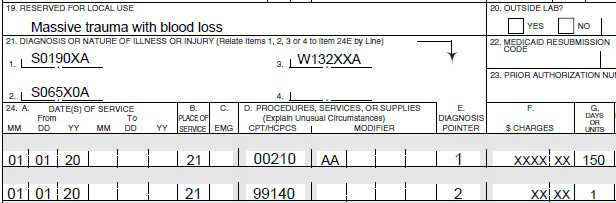
The modifiers used are as follows:
AA
Indicating the anesthesia was personally performed by the anesthesiologist
99140
Anesthesia complicated by emergency conditions (e.g., massive trauma with blood loss)
Note: Anesthesia risk modifiers should only be billed by the practitioner actually administering the anesthesia. In cases where a CRNA is administering anesthesia under the supervision of an anesthesiologist, the CRNA may bill the anesthesia risk modifier, but the supervising anesthesiologist may not.
Revision History
| Date | Nature of Revision |
|---|---|
| 08/03/2026 | Migrated to new platform. |