Choosing and assigning the correct diagnosis code ensure the efficient and accurate processing of your medical claims.
Correct diagnosis coding begins with selecting the appropriate diagnosis code(s) from the most recent edition of the ICD-9-CM/ICD-10-CM coding manual and using the most recent version of ICD-9-CM/ICD-10-CM Official Guidelines for Coding and Reporting which is found in the front of the ICD-9-CM/ICD-10-CM coding manual and updated in April and December of each year (to refer to the most current version, go to the National Center for Health Statistics (NCHS) Web site, or to the NCHS ICD-9-CM/ICD-10-CM Web page). These guidelines have been adopted under HIPAA.
HMSA accepts ICD-9 diagnosis codes entered to the fifth position and ICD-10 diagnosis codes entered to the seventh position. The following guidelines will help you to choose the most appropriate code:
- Select the diagnosis code with the highest number of digits available to describe the patient’s condition. For example, a diagnosis of cystitis must not be coded with the three-digit diagnosis code (ICD-9-CM 595/ICD-10-CM N30) because the code is further subdivided into fourth (for example, chronic interstitial cystitis, ICD-9-CM 595.1) and fifth (for example, abscess of the bladder, ICD-9-CM 595.89/ICD-10-CM N30.80) digit codes and a review and assignment of one of these more specific codes is required.
- Do not add zeros after the decimal to artificially create up to the fifth or seventh digit. Use the code up to the digit indicated.
- List a secondary diagnosis only when it has a bearing on the patient’s current medical condition and treatment. For example, if the patient’s diabetes complicates or otherwise affects a physician’s treatment of a foot ulcer, both diagnoses should be listed on the claim. The diagnosis most closely linked to the patient’s current complaint should be listed in the primary position.
- Do not list conditions for which the patient was previously treated and has since recovered, or has no bearing on the patient’s current complaint and treatment.
- For diabetes and certain other conditions, the underlying disease must be listed as the primary diagnosis, and manifestations of the disease be listed as secondary diagnoses.
- Be aware the ICD-9-CM/ICD-10-CM manual classifies some diagnoses as appropriate only for patients of a specific age or gender. It is important to read the text surrounding the diagnosis and to note specific symbols for age and gender as well as exclusions. For example, diagnosis ICD-9-CM 773.0/ICD-10-CM P55.0 (hemolytic disease due to Rh isoimmunization) includes the age indicator A:0, meaning that this diagnosis applies to newborns only. This code should not be used to code the diagnosis for a mother who is undergoing ultrasound prior to the birth of her baby. The correct diagnosis to enter for the mother is ICD-9-CM 656.1X/ICD-10-CM O36.019X (Rhesus isoimmunization).
If you do not have a current copy of the ICD-9-CM/ICD-10-CM manual, we urge you to purchase one and obtain an updated version every year. Please refer to Resource Books for information on ordering the current edition of the manual.
Claims Filing Information
In addition to selecting the most appropriate diagnosis for your patient, it is important to place the codes in Block 21 of the CMS 1500 claim form correctly.
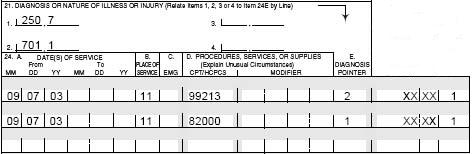
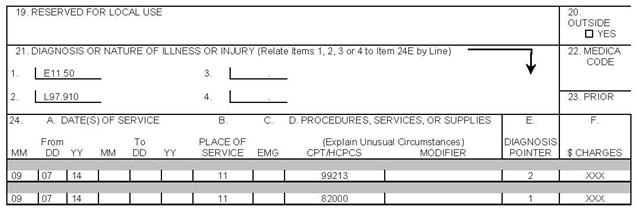
For example, if a patient was seen by the doctor for ulcers on his or her feet, and the doctor knows that the patient’s condition is a complication of his or her diabetes, the claim might be coded as follows:
- The primary diagnosis would be ICD-9-CM 250.7X/ICD-10-CM E11.5X (diabetes with peripheral circulatory disorders).
- An appropriate secondary diagnosis would be ICD-9-CM 707.1X/ICD-10-CM L97.91X (ulcer of lower limbs).
- An office visit to treat the patient’s foot ulcer would reference the secondary diagnosis, while a urinalysis done to test the patient’s glucose level would correspond more closely with the primary diagnosis and should be coded accordingly.
If the supporting reference number (1, 2, 3 or 4) from Block 21 is not entered in column 24E, the primary diagnosis will be used to support all of the services rendered, which may result in benefits being denied or processed incorrectly for individual procedures.
ICD-9-CM
ICD-10-CM
Up to 12 ICD-9/ICD-10 Diagnosis Codes Accepted on CMS 1500 Hard Copy Claims
Effective February 1, 2013 HMSA accepts up to 12 ICD-9 diagnosis codes on the current CMS 1500 paper claim form. This will also be effective for ICD-10 diagnosis codes on October 1, 2014. Write or type additional diagnosis codes in box 19 or 21.
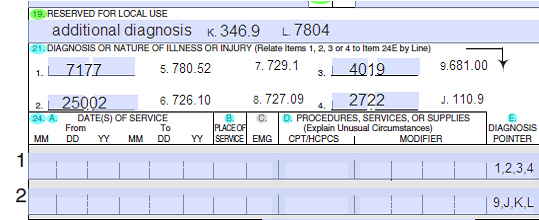
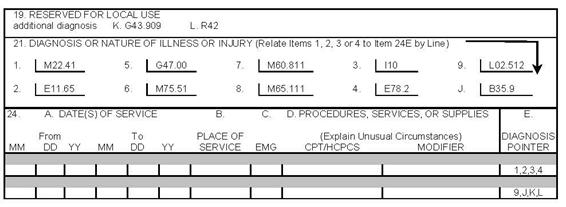
Be sure to label diagnosis codes and put them in order as follows: 1, 2, 3, 4, 5, 6, 7, 8, 9, J, K, and L. Claims with diagnosis code labels that do not follow this order or are missing a number in the sequence (e.g., 1, 3, 4) will be returned for correction.
Although you can list up to 12 diagnosis codes on a claim, the number of diagnosis code pointers for each service line in box 24E is limited to four per line. Please label the 10th, 11th, and 12th diagnosis codes and their corresponding diagnosis code pointers with the letters J, K, and L.
See the examples of diagnosis code labels and their corresponding pointers:
ICD-9-CM
ICD-10-CM
Revision History
| Date | Nature of Revision |
|---|---|
| 08/03/2026 | Migrated to new platform. |