Medicare Advantage plans include benefits for general and regional anesthesia. In addition, monitored anesthesia is covered when needed to treat patients who meet HMSA criteria for ‘high risk’ medical diagnoses. Monitored anesthesia is not a benefit of Medicare Advantage when it is performed primarily for patient convenience.
Monitored anesthesia is defined by HMSA as anesthesia that produces a controlled state of depressed consciousness or unconsciousness, accompanied by a partial or complete loss of protective reflexes (airway management). The agent is usually administered through intravenous infusion, or by a combination of local or regional anesthesia and certain mind-altering drugs.
Monitored anesthesia should be administered by qualified anesthesia personnel. For monitored anesthesia to be considered for benefit payment, the individual administering the anesthesia must be present and providing care during the entire procedure. The individual must also provide continuous evaluation of various vital physiologic functions and the diagnosis and treatment of any deviation in the patient’s condition. HMSA payment for monitored anesthesia includes payment for the provision of the anesthesia, as well as the pre-anesthesia examination and evaluation, anesthesia planning and post-operative anesthesia care.
To prevent misunderstandings when monitored anesthesia is planned but does not meet HMSA guidelines for coverage, the provider may wish to have the member sign an Acknowledgement of Financial Responsibility - Medical during the pre-anesthesia examination. The agreement should be kept in the patient’s medical record. The claim should be filed using modifier code GA, which indicates that the agreement is on file. The use of this modifier will allow the provider to collect from the patient for the noncovered services.
High-Risk Indications for Monitored Anesthesia
Monitored anesthesia performed by an anesthesiologist or CRNA may be considered for payment when services are performed for patients with the following ‘high risk’ medical diagnoses:
- Acute septicemia
- Diabetes (with blood sugars>300)
- Severe metabolic disorders (e.g., thyrotoxicosis, adrenal gland disorders)
- Electrolyte imbalance (sodium, potassium, and calcium levels outside normal limits)
- Morbid obesity (2x ideal body weight)
- Organic brain syndrome/dementia (with confusion, combative behavior and various types of psychoses)
- Severe anxiety, hysteria, panic attacks
- Phobic disorders
- Various types of drug dependency or drug abuse (acute detoxification state)
- Alcohol abuse (current, continuous or episodic)
- Intracranial abscess
- Alzheimer’s disease
- Seizure disorders (on appropriate anti-epileptic medication)
- Rheumatic fever with cardiac involvement
- Valvular heart disease or disorders
- Malignant hypertension (>110 diastolic or 180 systolic and on two or more hypertensive medications)
- Hypertensive heart disease (patient is acute, unstable and on multiple medications)
- Hypertensive heart and renal disease
- Acute myocardial infarction
- Other acute and subacute forms of ischemic heart disease
- Angina pectoris
- Other forms of chronic ischemic heart disease
- Acute and chronic pulmonary disease (severe)
- Other forms of heart disease such as pericarditis, endocarditis, myocarditis, or cardiomyopathy
- Life-threatening arrhythmias (e.g., tachycardia, ventricular fibrillation)
- Heart failure
- Acute cerebrovascular disease
- COPD and allied conditions
- Pneumoconioses or asbestosis
- Respiratory conditions due to chemical fumes and vapors and other external causes (e.g., radiation)
- Pneumothorax
- Pulmonary collapse, emphysema, edema, eosinophilia, or insufficiency
- Hepatic failure (bilirubin >3)
- Massive gastrointestinal bleeding (>500cc blood loss by history)
- Stridor
- Renal failure, acute or end-stage renal disease, or on dialysis (creatinine >2)
- Active hallucinations
- Convulsions (unstable patient on multiple medications)
- Hypotension or shock (systolic pressure <90)
- Severe allergic reactions
- Patients with very low pain thresholds or who suffer severe pain*
- Pediatric patients through age 11
*Document this factor in Block 19 of the CMS 1500 claim form and include a history and physical or anesthesia report documenting the patient’s intolerance to pain.
Documentation
If the primary diagnosis does not support the use of monitored anesthesia, then a secondary diagnosis should be used to indicate risk. The primary diagnosis will be the reason the surgery or procedure was performed. A notation should also appear in Block 19 of the CMS 1500 claim form or the ‘comments’ section for EMC, describing the patient’s high-risk condition.
Documentation should be in the patient’s record explaining the high-risk condition; describing the treatment the patient is receiving for the condition; and listing any medications the patient is taking to control the condition and the patient’s response to the medications.
Claims Filing Instructions
To report monitored anesthesia, use anesthesia five-digit procedure codes (see the Anesthesia section of CPT). Do not use CPT codes 99141 or 99142.
Monitored anesthesia should be represented by modifier code QS. High-risk modifiers should be used where appropriate. Use HCPCS modifiers G8 and G9 for patients with specific high-risk conditions. See the following page for criteria for use. An additional modifier also should be used to indicate who (e.g., anesthesiologist, CRNA) performed the service.
Example
The patient is a 69-year-old man with seizure disorders. His gastroenterologist performed an upper GI endoscopy to ascertain the reason for the patient’s chronic upper GI pain. Monitored anesthesia was ordered due to the patient’s ‘high-risk’ condition. An anesthesiologist administered the anesthesia. The endoscopy took 45 minutes to complete. The claim would be completed as shown below:
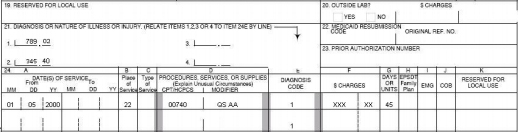
The modifiers used in the example are:
| QS | Indicating that monitored anesthesia was provided. |
| AA | Indicating that anesthesia was provided by an anesthesiologist. |
G8 or G9 modifiers were not used because the patient’s diagnosis did not meet the criteria of either modifier.
Recognized Modifiers
When coding claims for members covered under HMSA Akamai Advantage®, you may use any of the modifier codes listed below. The codes should be used as outlined below. The first list shows modifiers that describe the service and risks. The second list shows codes that describe who rendered the service. HMSA criteria are shown in italics.
| Risk/Service Modifiers | Description |
|---|---|
| G8 | Monitored anesthesia care for deep, complex, complicated or markedly invasive surgical procedure. Use this modifier for procedures on the face, neck or breast (CPT codes 00100, 00160, 00300 and 00400). You also may use this modifier for procedures that access central venous circulation (CPT code 00532) and for procedures involving male genitalia (CPT code 00920). |
| G9 | Monitored anesthesia care for patient who has a history of severe cardiopulmonary condition. Use this modifier when monitored anesthesia is required to prevent intraoperative catastrophes for patients with severe cardiopulmonary conditions. |
| QS | Monitored anesthesia care service. (When G8 or G9 is used, it is not necessary to use QS, as the descriptions of G8 and G9 indicate that the service is monitored anesthesia.) |
| 51 | Multiple procedures. |
| Professional Modifiers | Description |
|---|---|
| AA | Anesthesia services performed personally by anesthesiologist |
| AD | Medical supervision by a physician: more than four concurrent anesthesia |
| QK | Medical direction of two, three, or four concurrent anesthesia procedures |
| QX | Certified registered nurse anesthesiologist: with medical direction by a physician |
| QY | Anesthesiologist medically directs one CRNA |
| QZ | CRNA service without medical direction by a physician |
Note: As with Medicare, Medicare Advantage does not recognize the following modifier codes: AB, AC, XC, XF, or 49. In addition, if the following qualifying circumstance modifiers are used, they are considered to be included in the overall fee for anesthesia and will not be paid if billed separately: 99050, 99054, 99100, 99116, 99135 and 99140.
Examples of Modifier Use for Medicare Advantage
Example 1
Anesthesia is being given for the insertion of an implantable venous access device. The services are being performed by a CRNA under the direction of an anesthesiologist. The procedure code and modifiers would be listed as follows.
| Code | Modifier |
|---|---|
| 00532 | G8, QX |
QS was not used, because the description of G8 explains that the service is monitored anesthesia.
Example 2
A patient with severe anxiety, panic attacks and claustrophobia needs to be sedated so that an MRI can be performed. The services are performed by an anesthesiologist.
| Code | Modifier |
|---|---|
| 01922 | QS, AA |
In addition to a primary diagnosis indicating why the MRI is being performed, the claim should be supported with the appropriate psychiatric diagnoses. A G8 or G9 modifier is not used because the patient's diagnosis does not meet the criteria of either modifier.
Revision History
| Date | Nature of Revision |
|---|---|
| 08/03/2026 | Migrated to new platform. |